Henri Coandă Airport, 8:30 in the morning, five days of R&D and barely any sleep behind me. The checked bag came in at twenty-eight and a half kilograms instead of twenty-three; the carry-on at thirteen instead of eight. The man at the counter checked both in without charging a fee, and that small decision dissolved five days of stress in about four seconds. The stress came back when I landed in Vienna and went to collect my bags.
In the bags: the leek pibil, vac-packed. The prune and palinka (palinka – Romanian plum brandy) mole. The roasted celeriac it would coat. Three salsas, including a sunflower seed salsa macha. A large piece of aged sheep’s cheese. Loose camomile flowers. And the firm intention to serve three Mexican tacos at a natural wine fair in Vienna using not a single Mexican ingredient.
The constraint had been deliberate: Romanian ingredients only. Nothing that would not be commonly grown, produced, or preserved in Romania. No limes, no achiote, no epazote, no tomatillos. Whatever was at Obor Market (Bucharest’s central produce market) that week – its fresh stalls, its preserve sellers, its dried herb vendors, its fermented everything – was all there was to work with. In May, that turned out to be quite a lot.
The problem with not having limes
Every cuisine is built from a small set of structural decisions: how you add fat, how you add heat, how you add something deep and earthy, and – critically – how you add acidity. Mexican food answers the acidity question with lime. Sometimes with bitter orange. Sometimes with tomatillo. Remove all three and the whole architecture threatens to collapse into something heavy and one-note.
Romanian cuisine is not shy about acidity. It is just shy about it through different means entirely.
Borș (fermented wheat bran souring liquid) has been central to Romanian cooking for centuries. Scientifically, it is the product of natural lactic acid fermentation, dominated by Lactobacillus amylolyticus, a bacteria that converts sugars in the bran into lactic acid. This has been studied in detail. Lactic acid does not behave like citric acid, the main acid in limes. It is mellower, more persistent, rounded rather than sharp. It also carries the complexity of fermentation – phenolic compounds, subtle bitterness, aromatic depth – none of which you get from squeezing a fruit.
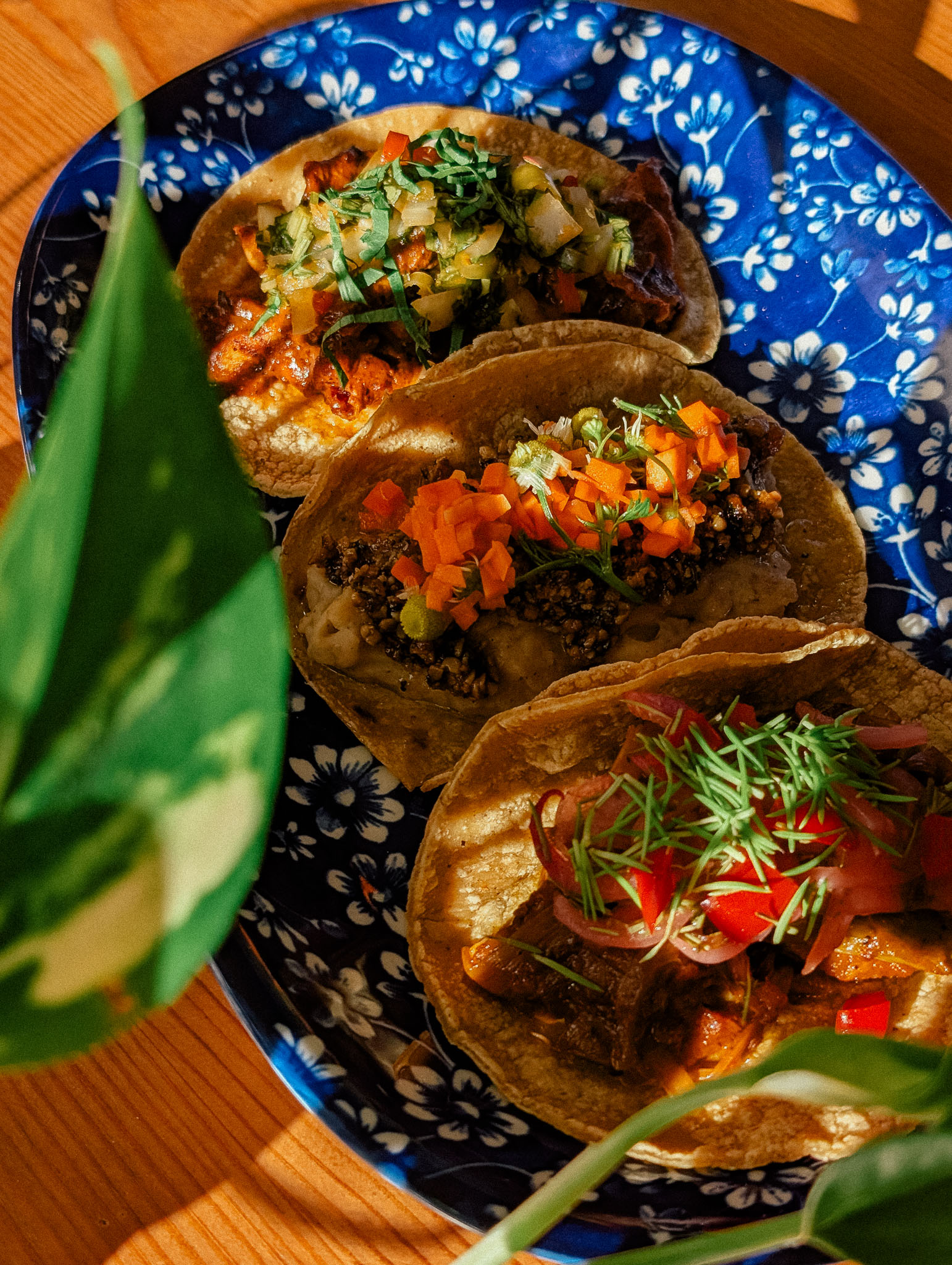
For the leek pibil marinade, the element replacing bitter orange in cochinita pibil, I used fresh borș combined with a borș reduction to concentrate the acidity without losing its character. To that went cordocușe (greengages) – a small plum-like fruit available at Obor in May, which contribute malic acid: rounder, juicier, more persistent than citric. Spruce tips brought their own tartness – bright, resinous, faintly lemony. The red onion and pickled pepper salsa topping the leek was marinated in this same no-bitter-orange juice and finished with more spruce tips.
The result carried the DNA of cochinita pibil – the same slow-cooked, heavily marinated quality, the same collapse of texture, the same sharp acidity cutting through fat. The ingredients were entirely different. The structural logic was identical.
Acidity is a function, not an ingredient. Different acids achieve it through different means and leave different traces on the palate. Once you accept that, the available options multiply. Romania has a long history of sourness rooted in fermentation – borș, sauerkraut juice, pickled gogosari (round red peppers), the brine of a dozen preserved vegetables. That history turned out to be exactly what was needed.
What cuisines share when you take the ingredients away
In 2011, a team of researchers led by Yong-Yeol Ahn at Northeastern University published a study in Scientific Reports mapping 381 culinary ingredients across more than 56,000 recipes, tracking the flavour compounds those ingredients share. The finding that attracted attention was that Western cuisines tend to pair ingredients that share flavour compounds, while East Asian cuisines tend to avoid it. What received less attention was the underlying implication: every cuisine, regardless of geography, is built from the same structural vocabulary. It needs acid. It needs fat. It needs aromatics. It needs heat. It needs something that anchors. The specific ingredients that fulfil each role differ dramatically across cultures. The roles themselves do not.
The leek pibil was not trying to impersonate cochinita pibil. It was applying the same logic – heavy marinade, slow cook, collapse, sharp relish on top – to what Obor Market had available in May. Same architecture. Different vocabulary.
The place where this became most clear was in the salsa that topped the celeriac and prune mole taco. In Mexican cooking, you reach for coriander. Its brief, bright herbaceousness cuts through the richness of mole and lifts everything underneath. In Romanian cooking, you reach for leuștean (lovage) – pungent, celery-forward, slightly anise, and deeply identitarian. It is the herb that makes ciorbă (Romanian sour soup) taste like itself, the one you smell before you taste. The two herbs share no meaningful flavour compounds and do not taste remotely similar.
The salsa for this dish contained white onions, leuștean, seabuckthorn juice, pickled chillies and salt. It was not a stand-in for anything Mexican. It was its own construction, built from two culinary cultures and beholden to neither – or perhaps beholden to both.
This is what I think cuisines actually share: not ingredients, not even specific flavour profiles, but logic. A commitment to balance. An instinct for contrast. A tendency to solve the same problems – richness, monotony, flatness – in the same directional way, using whatever the land happens to grow. Leuștean instead of coriander is not a workaround. It is a decision to let two identities coexist in the same bite. The point was never to find ingredients that taste the same. It was to find ingredients that do the same job while bringing something entirely their own.
The things you find when you cannot have what you want
Catrinel Haught-Tromp, a psychologist at Rider University, named her 2017 paper in Psychology of Aesthetics, Creativity, and the Arts the Green Eggs and Ham hypothesis – after Dr. Seuss, who wrote the book after his publisher challenged him to use only 50 unique words. Her finding: creative constraints do not reduce creative output. They tend to increase it. The mind, denied its default solutions, starts looking somewhere else. Constraint-based cooking does this reliably – you learn things about ingredients and how they interact that an open pantry would never have surfaced. Sometimes what you land on is more interesting than what you set out to make.
The lard-tasting beans were not planned.
For the second taco, I was building something between Mexican refried beans and fasole bătută (Romanian crushed white bean mousse, typically finished with oily, spiced sautéed onions). I cooked the beans from dried overnight, then split the batch – half crushed with a potato masher for texture, half blended into a cream for mouthfeel. I finished them with sunflower seed oil and a small drizzle of sauerkraut juice, partly to bridge towards the salsa macha and partly to cut the richness. The beans had caught slightly at the bottom of the pan, intentionally, for depth. I do not quite know what happened in that combination. The whole thing started tasting unmistakably of lard. Not flavoured with lard. Of lard. A happy and entirely unplanned discovery, the kind that makes the R&D part of this kind of cooking worth all the effort.
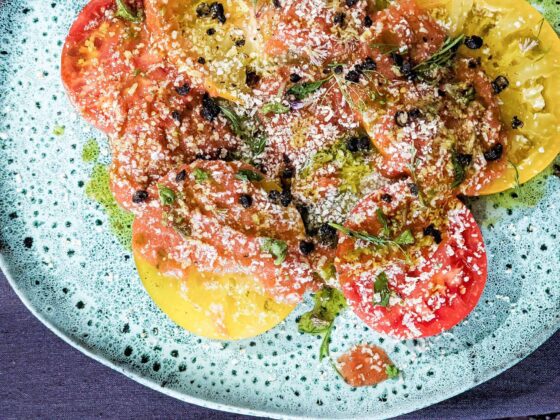
Camomile followed a similar logic. I bought it at Obor because it was everywhere that week – piled in enormous boxes next to the spruce tips. I had no specific plan for it. It ended up in the elderflower fizz (socată – Romanian fermented elderflower drink) marinade for the brunoise carrots topping the beans taco. It ended up on the tortilla chips, paired with isabella grape reduction mayo and aged Romanian sheep’s cheese – a dish that came together on the morning of the event, when I woke up knowing the cheese and the camomile wanted to be together on something crunchy. The pairing – super-aged, bold, faintly spicy sheep’s cheese against the almost medicinal floral note of fresh camomile – is not something I would have arrived at from a full Mexican pantry.
The sunflower seed salsa macha was built the same way. Salsa macha is typically made with dried chillies. The only dried chillies available at Obor in May were very hot and not much else. So I made my own chilli chicharrón (chilli chicharrón – fried fresh chilli slices, crisped in oil) from fresh green chillies, and built the salsa macha around roasted sunflower seeds, cold-pressed sunflower seed oil, poppy seeds, dried apricots, lightly fried garlic, and a finish of apple cider vinegar. It tasted clean and specific – like somewhere.
What was in the bags
There is a version of this story about fusion cooking, or about celebrating Romanian terroir, or about creative ingredient substitution. All of those readings are accurate. None of them quite land on what this was actually about.
Cuisines are not as foreign to each other as their ingredients suggest. The grammar is universal. The vocabulary is local. And when you commit fully to the vocabulary your land gives you – the borș, the leuștean, the spruce tips, the cordocușe, the sauerkraut juice, the prune and the palinka – and you trust the underlying grammar enough to translate from one culinary language to another, something real comes out the other side. Not a copy of either thing. Something that would not have existed any other way.
The man at the check-in counter let forty-one and a half kilograms of Romania into the hold of a flight to Vienna without charging a fee. What came out the other end was three tacos, a bowl of tortilla chips, and the firm conviction that leuștean deserves a place at far more tables than it currently occupies.
The full series documenting the Romanian-ish taco popup at Vinifair Vienna is on Instagram: Part 1 – behind the scenes / Part 2 – leek pibil / Part 3 – refried beans and sunflower seed salsa macha / Part 4 – prune and palinka mole. Links will be live once all four parts are published.